

Who is on the terrace
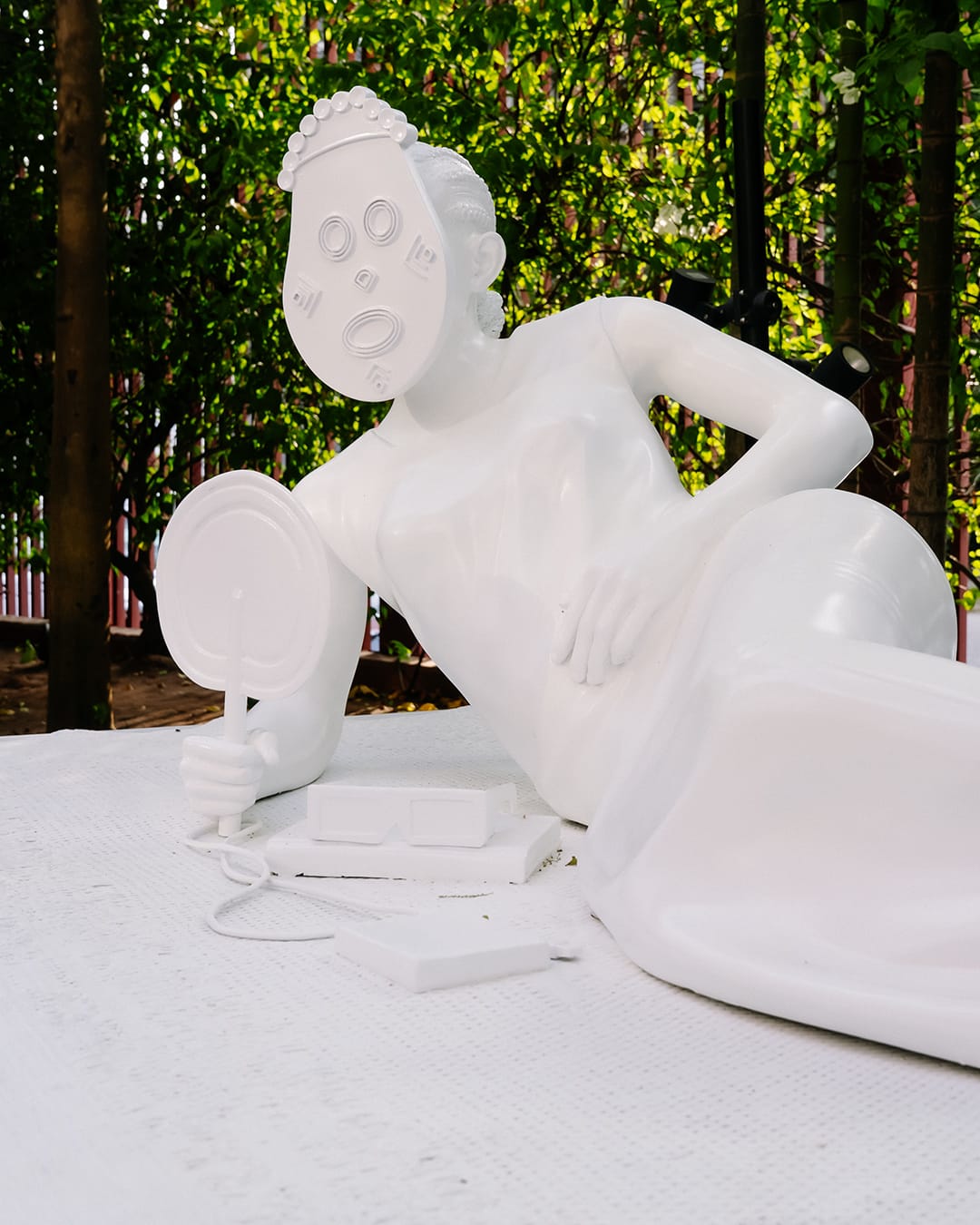
Somewhere between the burrata and the sushi pizza at VICI, a woman is lying on her side, completely unbothered. She is white from her beaded crown to the hem of her dress, propped up on one elbow on a woven mat, with a wall of green leaves and red railings behind her and two small spotlights watching her from a stand. Her face is one of Dennis Osadebe's masks, two round eyes and a round open mouth, and in her right hand she holds a fan. Follow the handle down and you find a cable, and the cable runs across the mat into a small white hard drive.
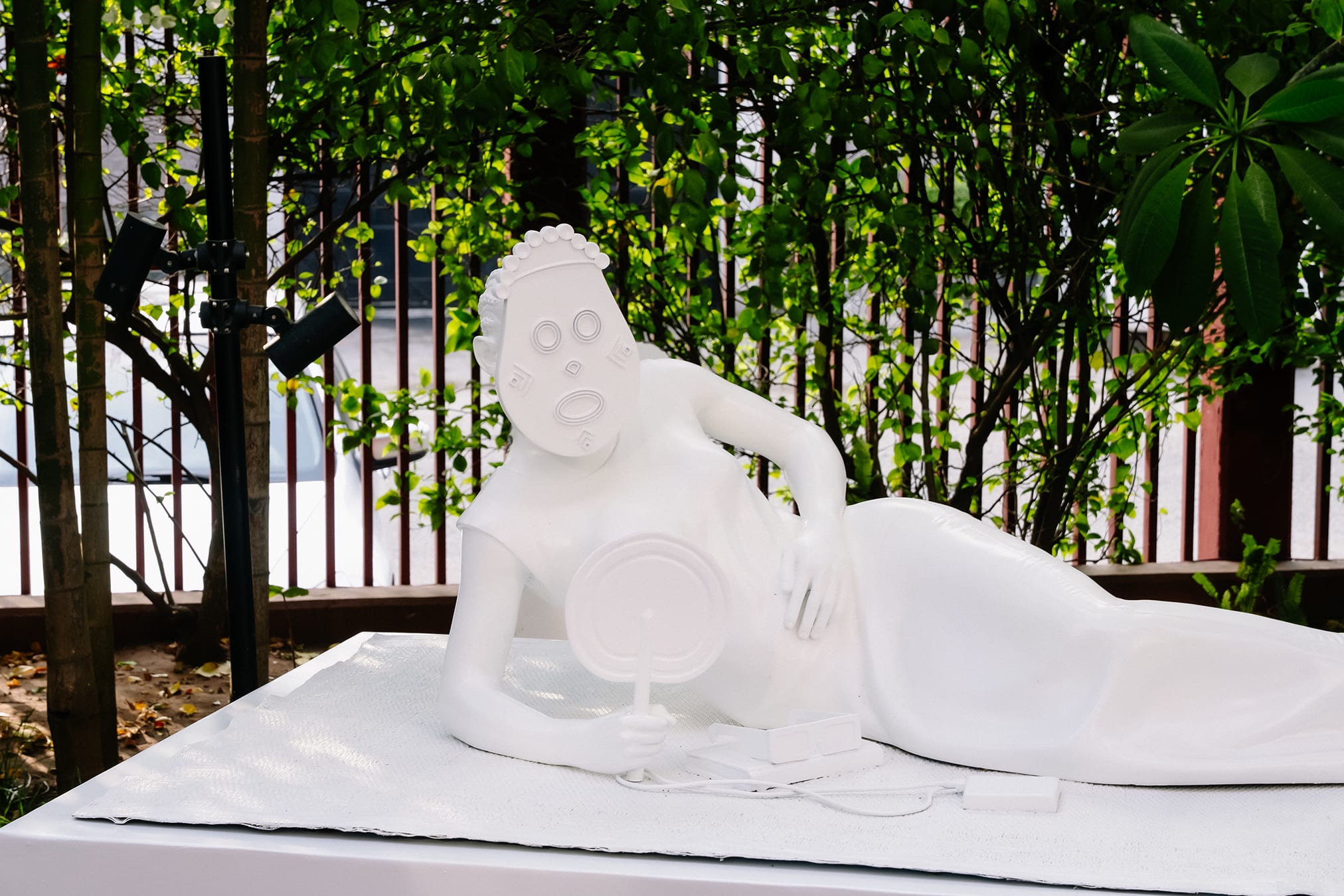
This is Reclining Woman (2025), and she will stay on the restaurant's open air terrace until 6 December, the same day the Lagos Biennial closes at Eko Atlantic. I find that timing funny in the best way. The Biennial's theme this year is The Museum of Things Unseen, a whole edition built around what a museum is, which stories get told and who gets to tell them, and it is also unveiling the Àkéte Collection, the Biennial's push towards a permanent public collection of contemporary art for Lagos. A short drive away, Lagos traffic permitting, a restaurant on Anifowoshe Street is testing the same question with a menu and a terrace.
What she is holding
Reclining Woman belongs to Osadebe's Forcing Connections series, and it takes its cue from the studio portraits of Adama Kouyaté, the Malian photographer who opened Photo Hall d'Union in Ségou in 1969 and spent decades photographing a newly independent Mali posing proudly in front of his backdrop. Kouyaté's sitters often brought the objects of their moment into the frame with them, and one of his 1967 photographs is simply titled Transistor. Osadebe has long named that generation of West African studio photographers, Seydou Keïta and Malick Sidibé alongside Kouyaté, as the people he learned from, and you can see the inheritance in the pose: the reclining body, the composure, the prop held close like proof of who you are and when you lived.
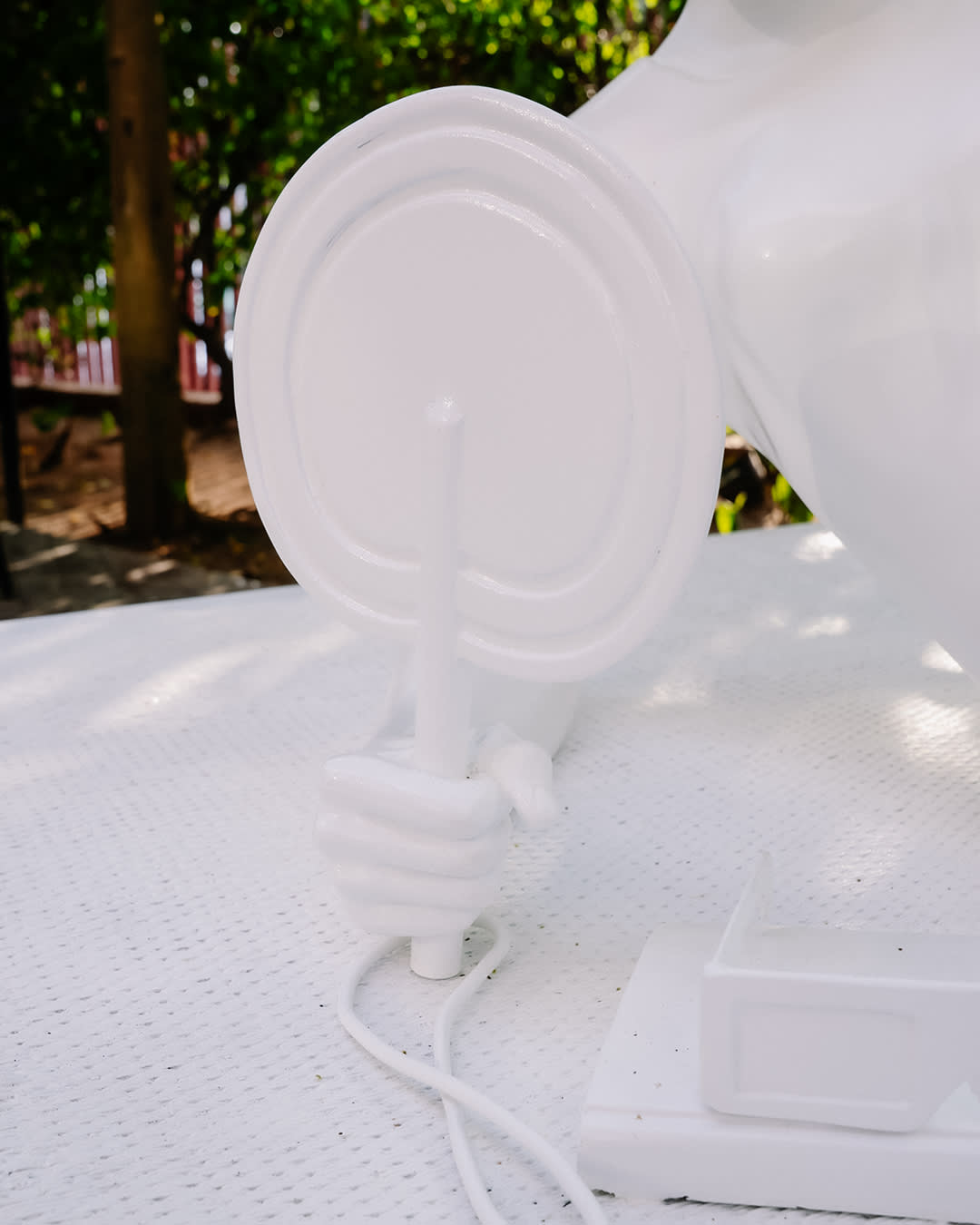
The prop has moved with the times. The studio describes the fan and the hard drive as a conversation between traditional practice and contemporary technology, and between the different ways knowledge is preserved and passed on. That reading holds. My Lagos reading is a little more practical. The hand fan is what every aunty in this city reaches for the minute the light goes, the one cooling device in the house that has never needed a socket, and Osadebe has gone and plugged it in.
I keep coming back to that cable. Half of what our parents knew reached us by mouth and by habit, and half of what we know now lives on drives and in clouds that can crash on a bad day, so wiring the oldest object in the room to the newest way we store memory feels less like a metaphor and more like a description of how most of us already live. The woman holding both of them looks perfectly relaxed about it, which might be the most Nigerian thing about the work.
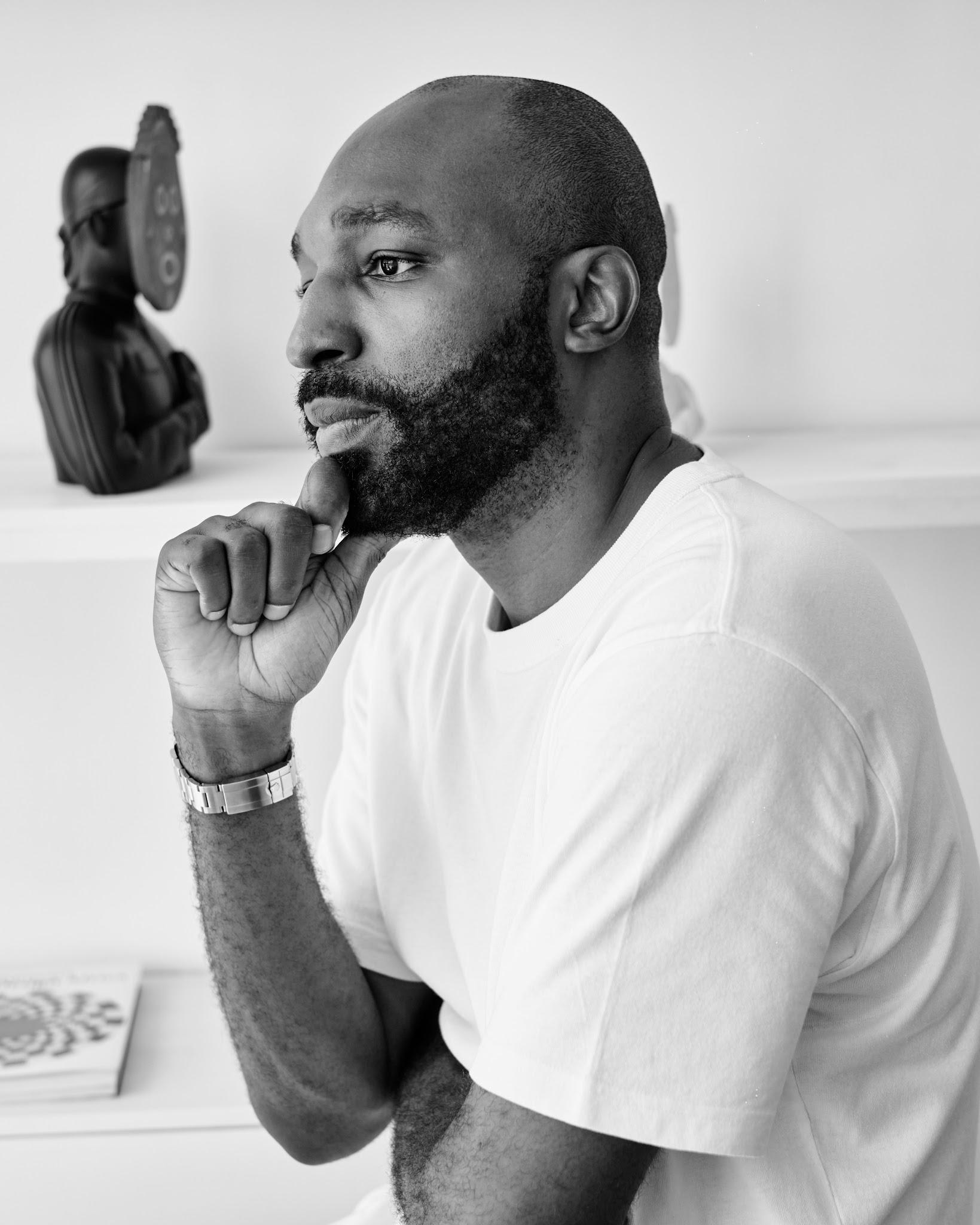
It also makes sense coming from Osadebe. Born in Lagos in 1991, he never went to art school; he studied business management, and it was his first MacBook that pulled him into the digital processes that still sit underneath his painted canvases. An artist who arrived at painting through a laptop understands better than most that the archive and the device are tangled together.
The restaurant question
The pitch behind this installation asks how restaurants, hospitality spaces and other social environments can become platforms for art and new audiences. Lagos has an older answer to that than people admit. A lot of the art in this city has always lived in bank halls, hotel lobbies, offices and private homes, places where you meet a painting because you came for something else.
What a terrace adds is the unguarded look. Nobody walks into VICI braced for an encounter with contemporary sculpture. You come for dinner, you sit down, and there she is, close enough to see the beading on her crown and the little box by her elbow. A gallery can hang the same work under perfect light and still never manufacture that moment, because the person walking into a gallery already knows they are there to look.
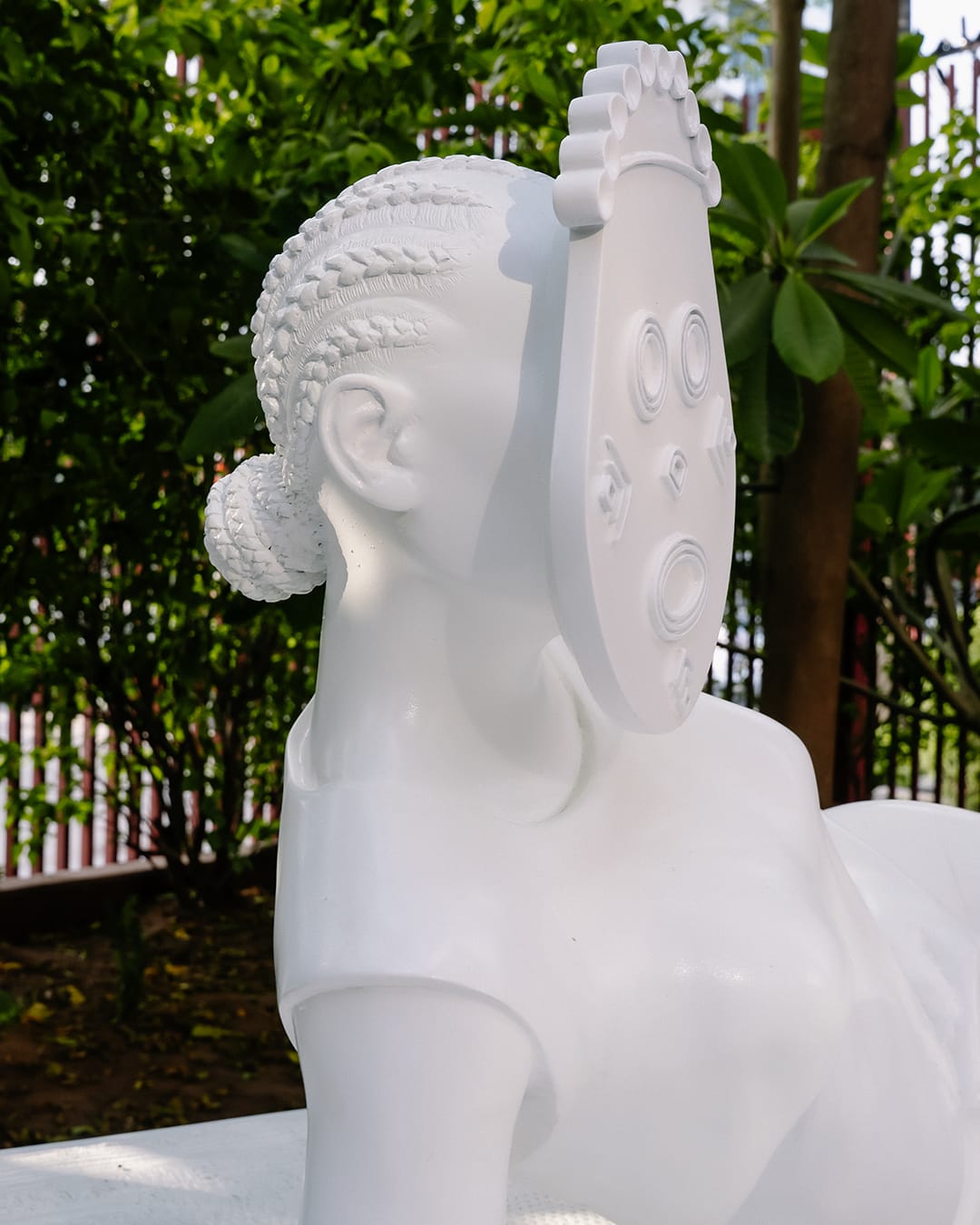
I also want to be honest about who is at the table. VICI is a premium Itameshi spot in VI, so the new audience this creates is still a particular slice of Lagos, and plenty of the photos taken with her this month will be Instagram stories with a cocktail in the foreground. I am fine with that. Every serious collector in this city had a first look somewhere, and for a lot of young Lagosians the first time they stand in front of a Dennis Osadebe might be on the way to the bathroom on a Friday night. The bigger test is whether this stays a Biennial season moment or whether more spaces, at more price points, decide that the walls and terraces they already have are worth handing to artists.
Go and see her
Reclining Woman is on view at VICI Lagos on Anifowoshe Street, Victoria Island, until 6 December. If you are doing the Biennial at Eko Atlantic, make her your second stop. If you are not, go anyway, order something, and take the seat that faces her. Harmattan is on its way, and a white sculpture in an open air garden in December is a race against the dust.