

I started thinking about this earlier today, while returning to something I hadn’t done in almost eight weeks: keeping a proper pen-and-paper journal. I had quite a bit to catch up on. There were experiences I wanted to revisit, thoughts I hadn’t written down and little observations I hoped I could still recall in fragments. But somewhere in the middle of my first morning entry, my thoughts wandered towards work.
I’d just published my weekly deliverable for Digital Escape Africa, a role that currently requires me to put out at least one post every week. Getting that particular article out had involved a fair amount of floundering. I’d spent time trying to settle on an idea, working through different angles and wondering which was really worth pursuing.
Having finally published it, I thought I’d at least beaten the deadline. Then I questioned myself: had I, actually?
The uncertainty came from something I hadn’t really considered since entering a more conventional working environment. When does the working week end? Friday? Saturday? Sunday?
You know those seemingly little things that people tend to define differently? Yeah, that.
It occurred to me that I might have been measuring my week differently from the people around me. I’ve spent a considerable amount of time in the trading world, and some of its routines have quietly become part of mine. For anyone familiar with cryptocurrency trading, the weekly candle closes at 1 a.m. on Monday in my time zone. The daily candles close at that same hour each day.
Consequently, I’ve become accustomed to treating Sunday night, or even the early hours of Monday, as the end of my week. It’s a routine I’ve followed for so long that I hadn’t considered how differently someone working a Monday-to-Friday schedule might understand the same period.
Neither perspective is particularly odd. They’re simply products of different routines.
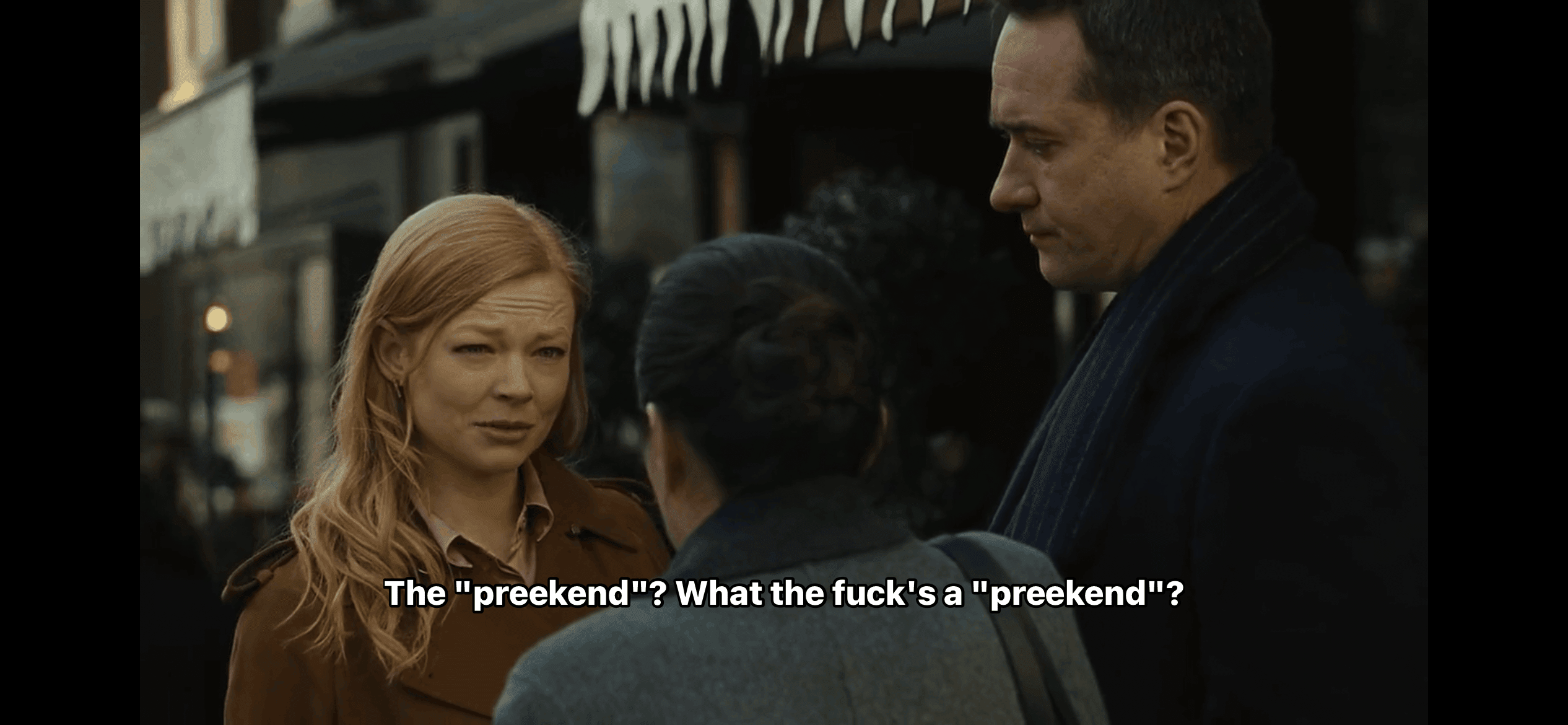
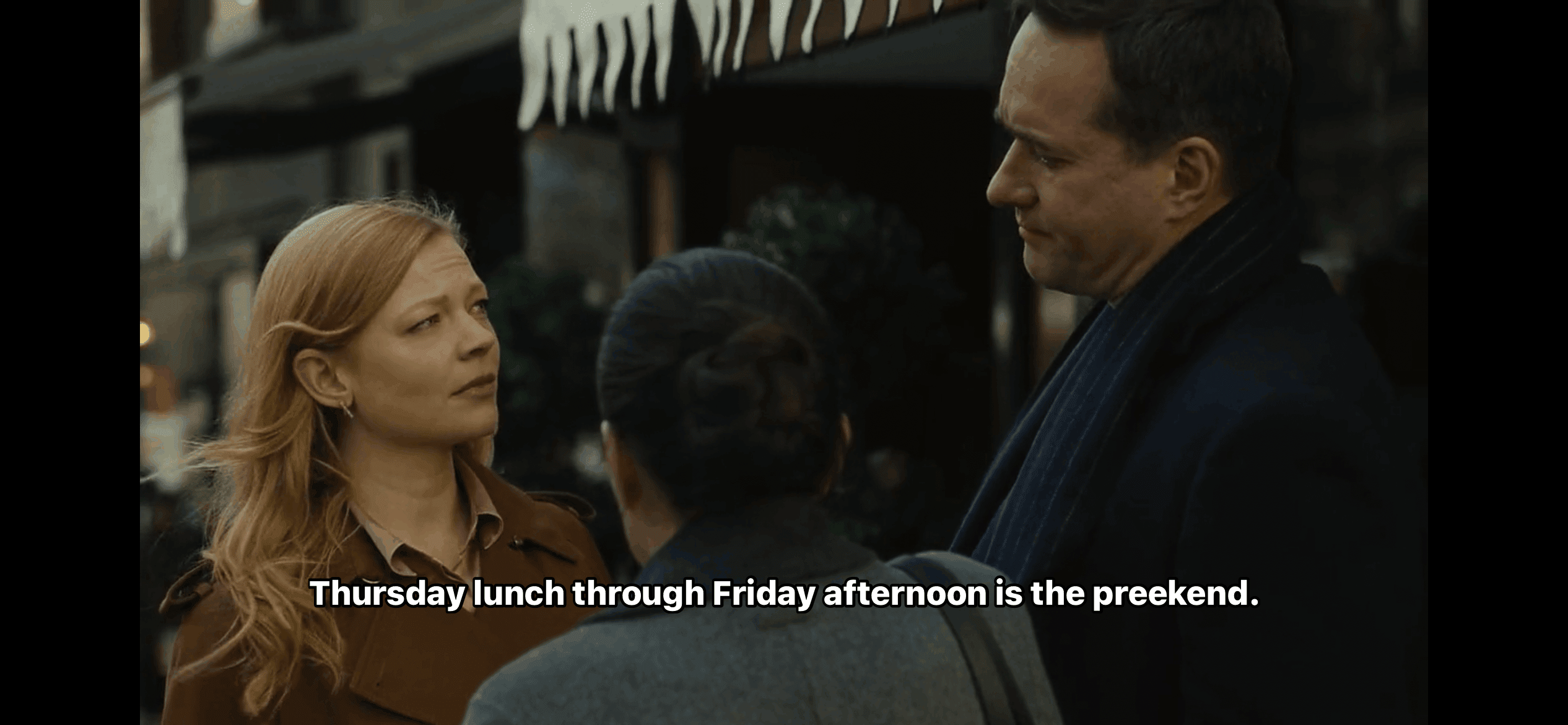
This also reminds me of a scene in Succession, where Shiv is unfamiliar with the term “preekend” and her then-fiancé, Tom Wambsgans, explains it as the period between Thursday lunchtime and Friday afternoon. Apparently, even the weekend has a prequel.
It’s a funny little exchange, but it speaks to the same thing: we don’t always experience or define time in quite the same way.
And that got me thinking about how many other seemingly ordinary things we understand differently.
A friend once sent me a message saying “Good afternoon” at 4:26 p.m. I casually replied, “good evening.” She responded: “Oh, evening starts from 4 p.m., yeah? I thought it was 5 p.m. Good evening.”
I found the exchange amusing. We went back and forth debating when afternoon officially gives way to evening, and even joked about it weeks later. Nothing was at stake in that case. We were just two people who had drawn the line at different points in the day. Why should one person’s afternoon be another person’s evening?
The interesting part is that we rarely notice our own definitions until they meet someone else’s.
I was reminded of this during my early days at Digital Escape Africa. Our Head of Operations, Mr. Sam, was briefing me on the organization's weekly meetings and their scheduled times. I remember him mentioning that he expected people to arrive early. But he was particular about what he meant by early: he wasn’t referring to arriving at the exact scheduled time. He meant being there ahead of it.
And honestly, I agreed with him. The standard dictionary definition of early is “happening or done before the usual or expected time.” Yet, even with a definition readily available, people can still have different interpretations of what arriving early actually means. Is five minutes enough? Fifteen? Does arriving at the exact time count as punctual, or have you already missed the mark?
It struck me as another example of how we attach slightly different meanings to seemingly straightforward things. Mr. Sam had his understanding of early, my friend and I had ours of when evening begins, and I’d somehow developed my own understanding of when a week ends.
None of these differences is particularly extraordinary. In fact, they’re probably so ordinary that we rarely stop to examine them. Perhaps that’s what makes them interesting. We tend to assume that the meanings we attach to things are shared, simply because we’ve grown accustomed to them. We forget that our interpretations are often shaped by our individual experiences, routines, environments and the people around us.
Most of the rules we live by are agreements we never signed. Some are established conventions; others are habits we’ve picked up along the way. We learn them, adopt them and eventually treat them as though they’ve always been there. And every now and then, someone comes along with a slightly different interpretation.
Maybe the question isn’t which person is right about when evening begins, when a weekend starts or what it means to arrive early. But rather simply worth recognizing that these little things don’t always mean quite the same thing to everyone.